JavaOne 2017
Event Sourcing with JVM Languages
About Me
Wanted Event Sourcing in 2016
Didn’t like anything I saw
Built my own thing - Grooves
I solve problems in Health Care
Where I work

Transcend Insights® empowers population health management with The Platform Above—technology that rises above the data silos and connects care teams with the insights they need to succeed in a value-based care world.
About You
 |  |  |  |
What is Event Sourcing
Treat your database like you treat your application logs
What does that mean
Create
Read
Update
Delete
Bad Example 1
Mark and Jane share a bank account. The account has a balance of $75. Mark goes to an ATM and withdraws $50. At the same time Jane attempts to withdraw $50.
This is what our code looks like
@Transactional
boolean withdraw(String accountNumber, double amount) {
  double balance = accountService.getBalance(accountNumber);
  if (balance > amount) {
    balance -= account;
    accountService.setBalance(accountNumber, balance);
    return true;
  } else {
    return false;
  }
}What banks typically do

By Deutsche Bundespost (Scan by User:Mattes) - Scan (700dpi, Millionen Farben), Public Domain Wikimedia
But that was Banking
If you can look at your logs and debug your application, you are already doing that.
Banks defined their business model this way hundreds of years ago.
What about my domain?
| | |
What about my domain?
| | |
Computing Snapshots
\$S_N = f(S_0 , E_1..E_N)\$
\$S_N\$ | Snapshot at Version N |
\$S_0\$ | empty snapshot |
\$E_1..E_N\$ | events from position 1 through N |
\$f\$ | query |
But it’s not that simple
Incremental Computation
This is what we would like to do
\$S_N = f(S_K , E_(K+1)..E_N)\$
In Mathematics, it’s called the distributive property
\$a+b+c = (a+b) +c\$
We’re not done yet
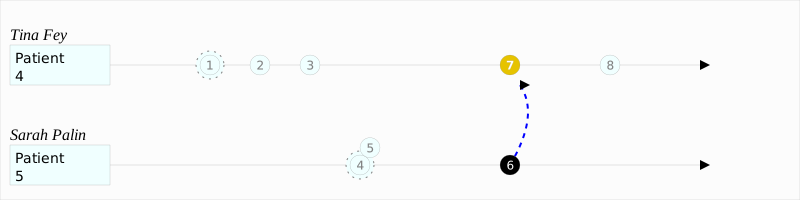
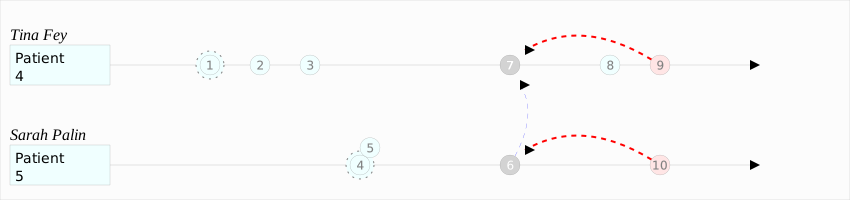
There are special events
Revert


Revert Again


Merge/Deprecate
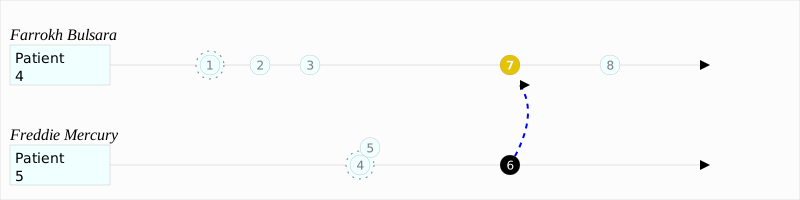

Reverting a Merge
Bad Example 2
Employee
| Department
|
Joins in Event Sourcing
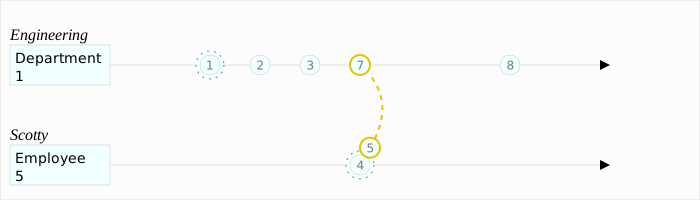
Disjoins too
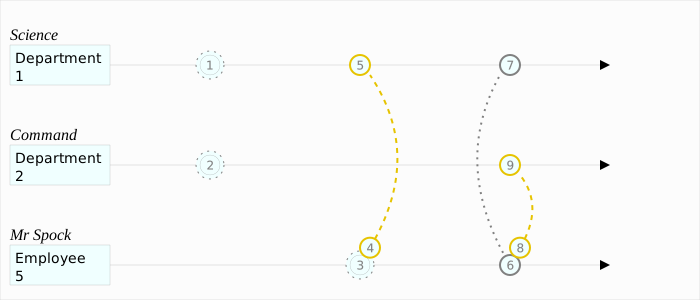
Grooves Domain Objects
Aggregates
public class Patient implements AggregateType<Long> {
    private Long id;
    private String uniqueId;
}Events
public abstract class PatientEvent implements
        BaseEvent<Long, Patient, Long, PatientEvent> {
    private Patient aggregate;
    private Long id;
    private String createdBy;
    private RevertEvent<Long, Patient, Long, PatientEvent> revertedBy;
    private Date timestamp;
    private Long position;

    @Override
    @NotNull
    public Observable<Patient> getAggregateObservable() {
        return aggregate != null ? just(aggregate) : empty();
    }
}Real Events
public class PatientCreated extends PatientEvent {
    private String name;
}Special Events
public class PatientEventReverted
        extends PatientEvent
        implements RevertEvent<Long, Patient, Long, PatientEvent> {
    private Long revertedEventId;
}Snapshots
public class PatientAccount
        implements JavaSnapshot<Long, Patient, Long, Long, PatientEvent>,
        Serializable {
    private Long id;
    private Patient aggregate;
    private Patient deprecatedBy;
    private List<Patient> deprecates = new ArrayList<>();
    private Long lastEventPosition;
    private Date lastEventTimestamp;

    private String name;
    private BigDecimal balance = new BigDecimal(0);
    private BigDecimal moneyMade = new BigDecimal(0);

    public Observable<Patient> getAggregateObservable() {
        return just(aggregate);
    }

    public Observable<Patient> getDeprecatedByObservable() {
        return just(deprecatedBy);
    }

    public Observable<Patient> getDeprecatesObservable() {
        return from(deprecates);
    }
}Grooves Queries
Satisfying grooves
public class PatientAccountQuery<...> extends QuerySupport<...> {
    ...
}
Could also be VersionedQuerySupport or TemporalQuerySupport
Fetching snapshots
    @Override
    public PatientAccount createEmptySnapshot() {
        return new PatientAccount();
    }

    @Override
    public Observable<PatientAccount> getSnapshot(
            long maxPosition, Patient aggregate) {
        ...
    }

    @Override
    public Observable<PatientAccount> getSnapshot(
            Date maxTimestamp, Patient aggregate) {
        ...
}Fetching events
    @Override
    public Observable<PatientEvent> getUncomputedEvents(
            Patient aggregate, PatientAccount lastSnapshot, long version) {

    }

    @Override
    public Observable<PatientEvent> getUncomputedEvents(
            Patient aggregate, PatientAccount lastSnapshot, Date snapshotTime) {

}Handling errors
    @Override
    default Observable<EventApplyOutcome> onException(
            Exception e, PatientAccount snapshot, PatientEvent event) {
        getLog().error("Error computing snapshot", e);
        return just(CONTINUE);
}Processing events
For languages like Java, Groovy
    public Observable<EventApplyOutcome> applyPatientCreated(
            PatientCreated event, PatientAccount snapshot) {
        if (snapshot.getAggregate() == event.getAggregate()) {
            snapshot.setName(event.getName());
        }
        return just(CONTINUE);
    }

...Processing events
For languages with case classes
    override fun applyEvent(
        event: PatientEvent.Applicable, snapshot: PatientAccount) =
            when (event) {
                is PatientEvent.Applicable.Created -> {
                    // Your logic here
                    just(CONTINUE)
                }
                is PatientEvent.Applicable.ProcedurePerformed -> {
                    // Your logic here
                    just(CONTINUE)
                }
                is PatientEvent.Applicable.PaymentMade -> {
                    // Your logic here
                    just(CONTINUE)
                }
}Events
For languages with case classes
sealed class PatientEvent : BaseEvent<..> {
    // Properties and methods from equivalent java class

    sealed class Applicable : PatientEvent() {
        data class Created(val name: String) : Applicable()
        data class ProcedurePerformed(
                val code: String, val cost: Double) : Applicable()
        ..
    }

    data class Reverted(override val revertedEventId: String) :
            PatientEvent(), RevertEvent<..>
}Completeness for Java
…and Groovy.
@Aggregate public class Patient {...}
public abstract class PatientEvent {}

@Event(Patient.class)
public class ProcedurePerformed extends PatientEvent {}
@Event(Patient.class)
public class PaymentMade extends PatientEvent {}

@Query(aggregate=Patient.class, snapshot=PatientAccount.class)
public class PatientAccountQuery {
    ...
    Observable<EventApplyOutcome> applyProcedurePerformed() {...}
    Observable<EventApplyOutcome> applyPaymentMade() {...}
}Usage
Patient patient = ...
Observable<PatientAccount> account;

// By Date
account = patientAccountQuery.computeSnapshot(patient, new Date());

// By version
account = patientAccountQuery.computeSnapshot(patient, 7L);
Gotchas
How many Tour de France General Classification Tour victories did this guy have on 2007-10-01?
EPA/JASPER JUINEN, 22 July 2004. Sourced from vosizneias
Lance Armstrong
|
|
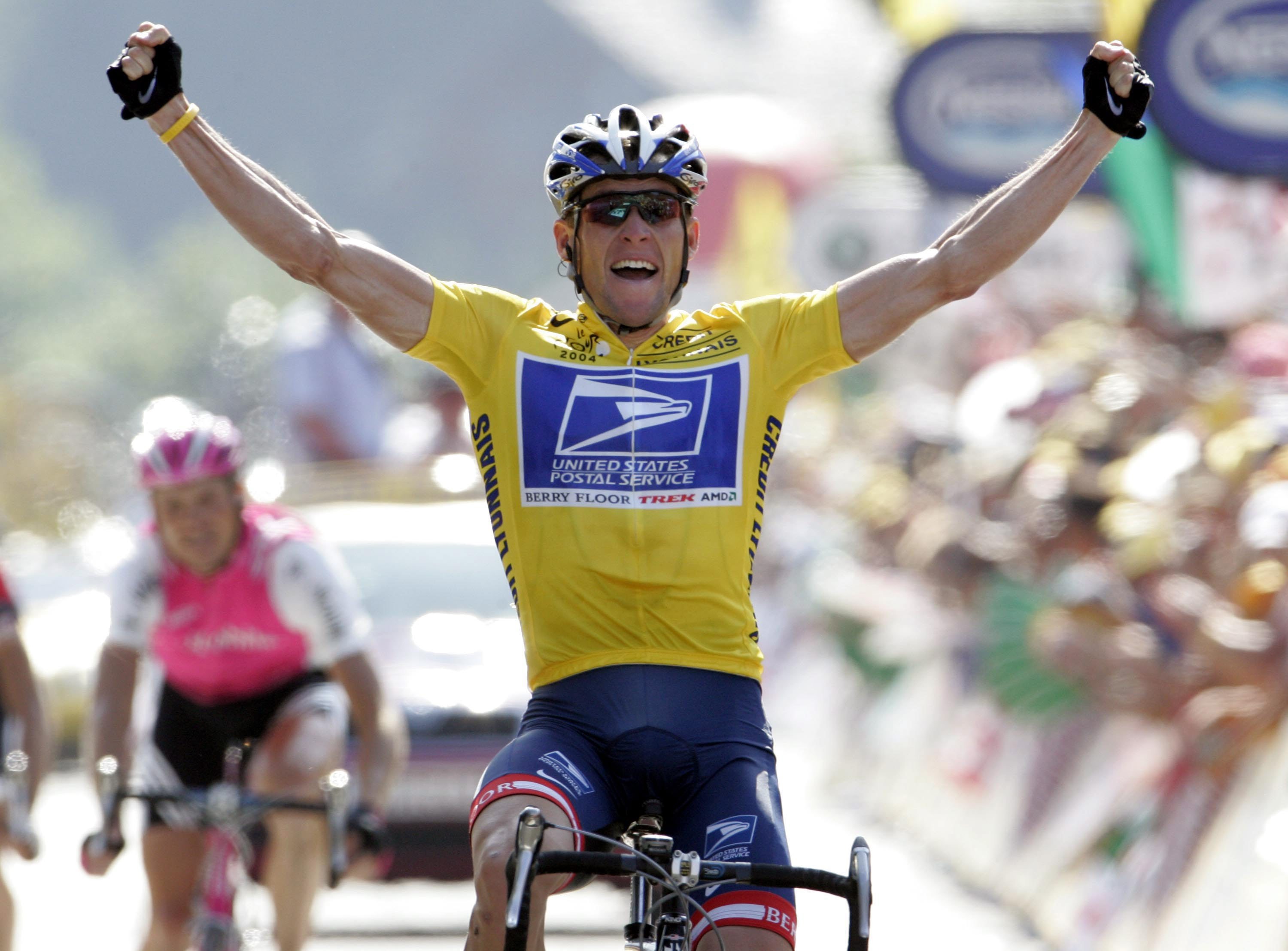
1. Based on what we knew in 2007, How many TdF GC Tour victories did he have on 2007-10-01? | 2. Based on what we know in 2017, How many TdF GC Tour victories did he have on 2007-10-01? |
Ask the right question
Advice on handling data
Be very careful about what your events look like.
Don’t worry much about what your snapshots look like.
Communication is key
95% of the cost of event sourcing projects is explaining event sourcing
— Scott Bellware (@sbellware) June 11, 2017
Non Event Sources of data
When the intent of the user is not clear from the datasource.
The Story of Goldilocks and The Three Bears, Award Publications LTD
Thank you
Slidedeck | |
Grooves |
Sun 15:00 | CON7610 | Microservices Data Patterns: CQRS and ES |
Mon 16:30 | CON2526 | Reactive Stream Processing with Swarm and Kafka |
Mon 17:30 | CON7474 | ES, Distributed Systems, and CQRS with Java EE |
Tue 13:15 | CON4083 | Async by Default, Synchronous When Necessary |
Wed 14:45 | CON4277 | Three µS Patterns to Tear Down Your Monoliths |